 BACK TO HOMEPAGE >
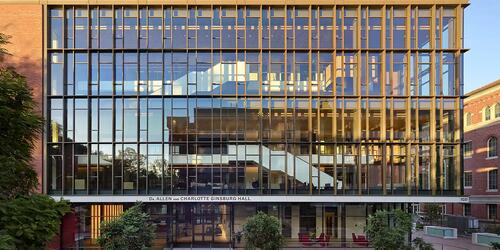
University of Southern California Dr. Allen and Charlotte Ginsburg Human-Centered Computation Hall | Los Angeles, California, USA | 2024
Architects: Helmuth Obata Kassabaum (HOK)
Design Team: Paul Woolford, David Frey, Paul Woolford, David Frey, Jessica Ginther, Jeffrey Stafford, Tim DeCoster, Daniel Herriott, Nadeen Tarazi, Willie Nishizawa, Brian Jencek, Shannon Cain, and Carl Johnson
General Contractor: Turner Construction Company
Client: University of Southern California
Photographers: Alan Karchmer Architectural Photographer
The Dr. Allen and Charlotte Ginsburg Human-Centered Computation Hall at the University of Southern California (USC) is a place for the convergence of science and discovery. Ginsburg Hall is infused with spaces that promote exchange, upon entry into the lobby, the floor steps down to an amphitheater.
Pinwheeling off this two-story social space is an auditorium, drone aviary, sunken garden and student lounges. This ‘town square’ provides a multi-dimensional place where people central to science will converge. To quote President Carol Folt of USC: “Ginsburg Hall is a home for the next generation of creators, inventors and discoverers. It is literally building the future — across every field of human endeavor.”
The theme “science on display” resonates throughout the building. The open plan maximizes transparency and integration among laboratories, offices, and public spaces. Double-story “porches” across the southern façade welcome the fusion of work, research, and social engagement to emerge beyond computational and robotic laboratories. The porches serve as environmental buffers that temper the experience between conditioned spaces inside and nature outside; and enable serendipitous encounters among students, researchers, and visitors.
Slated to become USC’s first LEED Platinum, all-electric, Net-Zero Emissions building, the Ginsburg Human-Centered Computation Hall sets a precedent for the university’s ambitious goal to achieve carbon-neutrality. Situated in the west quadrant of campus, this cutting-edge hub is a physical embodiment of USC’s mission to advance ethical, social and “human-centered” dimensions of computing, infusing it with disciplines across the university.
Taking advantage of California’s mediterranean climate, the design integrates a “passive solutions-first” approach towards energy conservation and occupant comfort. The optimized façade meets solar heat gain targets while enabling daylight to permeate deep into the building. Coupled with radiant cooling and heating, the buffer façade creates comfortable environments for collaboration and provides sweeping views to the Baldwin and Hollywood Hills. A rooftop photovoltaic system and dedicated offsite solar array produce 100% renewable energy to enable a Net-Zero Emissions, all-electric building.
Following equitable design principles, the interior caters to a complex program and the needs of a neurodiverse population. While the porches’ irresistible stairs and open space encourage active collaboration, the plan reveals labs that support congregation, open learning. Co-creation zones form the center where focused invention occurs, and a concentration zone lines the north façade with quiet areas, ambient daylight and calm. Biophilic elements, materials, furniture and finishes were curated to meet specific targets for embodied carbon, green chemistry and sustainable sourcing.
Designed as a “Living Lab”, the building reinforces the facility’s sustainable aspirations, enabling occupants to interact with building systems and the surrounding environment. Researchers learn from and work to advance building’s technologies through smart meters and sensors, improve their impact on energy conservation and human health and wellbeing. The design aims to benchmark smart building processes and best practices to inform and replicate on future projects.
This immersive research facility serves as a pilot, establishing rigorous benchmarks for all new USC campus facilities while enabling the next generation of creators, inventors and discoverers to advance the digital revolution and solve the world’s most pressing, human-centric problems.
“The principal goal of an education in computing is to create people who are capable of doing new things, and not simply of repeating what other generations have done. That belief will always resonate here at Ginsburg Hall.” – Carol Folt, President of USC.


