 BACK TO HOMEPAGE >
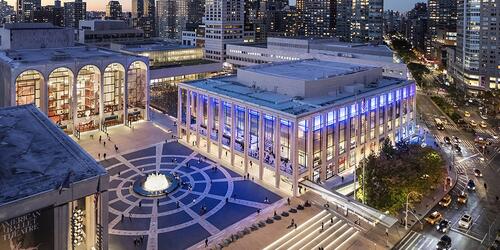
David Geffen Hall at Lincoln Centre | New York, New York, USA | 2022
Architects (Master Plan and Concert Theater): Diamond Schmitt
Lead Architect: Gary McCluskie
Associate Architects (Public Spaces): Tod Williams and Billie Tsien Architects|Partners
Lead Architects: Tod Williams and Billie Tsien
General Contractor: Turner Construction Company
Client: Lincoln Center for the Performing Arts and The New York Philharmonic
Photographers: Michael Moran, Chris Lee, and Richard Barns
David Geffen Hall, home to the New York Philharmonic, at Lincoln Center is more than a music hall, it is a cultural landmark. Designed originally by Max Abramovitz in 1962, the hall has gone through multiple renovations over the decades. These efforts attempted to address longstanding acoustical challenges amongst other issues, which remained unresolved until the completion of its most recent renovation.
Working closely with both Lincoln Center and the New York Philharmonic, the architectural team designed the new facility to be inviting, comfortable, warm, glamorous, and adaptable for an array of spatial arrangements, programming opportunities, and performance modes. Both institutions had a goal of not only providing a world-class concert facility but also opening their offerings to new audiences. This reimagination project reconceives the entire facility while respecting the existing iconic, historic shell. The foremost objective of the full-scale, interior re-design was to create a more welcoming and intimate audience experience and to accommodate state-of-the-art acoustics and technical capabilities. The architectural team also worked to enhance circulation, improve accessibility and sustainability, facilitate visitor flow, and expand food and beverage services.
Choreographed to maximize comfort and flexibility, the main lobby was envisioned to act as a living room for New York City. By removing extraneous ticket booths at the entrance, the square footage of the lobby more than doubled. Finishes and furnishings with vivid colors, patterns, and textures mirror the spirit and vibrancy of the performance. The main lobby is also acoustically tuned to accommodate various types of performances, as well as simulcast performances from the hall without the need for a paid ticket. By relocating the escalators, newly available space was re-purposed for a Welcome Center and Restaurant on the ground floor, expanding Campus amenities. To the north of the building, existing offices were relocated to the upper floors, freeing up the ground floor perimeter for public access. On the northeast corner, a newly introduced Sidewalk Studio acts as a living billboard for Lincoln Center and the Philharmonic's programming. The space functions as an intimate, yet highly visible performance space with embedded technical equipment to accommodate musical performances, screenings, lectures, and community meetings - all at street level. Onlookers from Broadway can see all the activity within. On the upper floors, the renovation project improves the entire concert-going experience, most notably at the heart of the building in the new state-of-the-art concert hall.
The design transforms the existing hall from a cavernous rectilinear shoebox into a curvilinear, unified room with flawless acoustics and optimized sightlines. Guided by acoustical principles, the seating of the hall was reduced from 2,700 to 2,200, improving access to sound and allowing for a more intimate connection between the audience and performers. The approach to design and material choices came from a strong desire to make everyone who comes to the concert hall - audiences, artists, and staff - feel immediately welcome. The warm, rippled beech wood paneling evokes the interior of a musical instrument, creating an idealized environment for musicians and audiences alike. Built on the “surround hall” concept, the proscenium has been eliminated, and the stage has been relocated 25 feet towards the center of the room, whereby seating now wraps the stage and the entire audience is closer to performers‚ optimzing the visual and acoustical experience. Supported by its new infrastructure, the hall is a flexible performance space that is readily adaptable for a wide range of stage and seating configurations, including orchestra, solo performances, film, pop concerts, and staged opera. It is enveloped by the warmth of natural molded beech wood walls that ensure reverberation, bass, and sound differentiation. In addition to its new versatility, the hall is also supported by updated back-of-house facilities to accommodate the wide-ranging needs of performers and production teams.
Opened two years ahead of schedule and on budget, the new David Geffen Hall offers an immersive home for the New York Philharmonic and embodies Lincoln Center's dedication to making exceptional arts and culture accessible to all.


